
1:1 Consultation
Mint Thread Lift Guide: Technique, Candidates & Results
Mint thread lift uses absorbable PDO threads to lift mild facial sagging. Learn the technique, candidacy, FDA status, and expected results at Aube Clinic.
Aube Clinic · Dr. Suhyun Kim, M.D. · Yongsan-gu, Seoul
1:1 Consultation →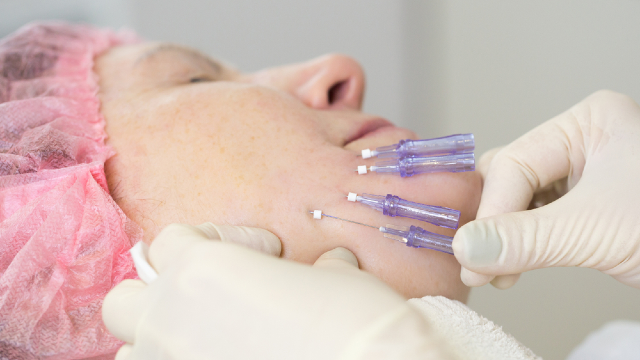
Medically reviewed by Dr. SuHyun Kim, Medical Director, Aube Clinic
The Mint thread lift is one of the more widely recognized absorbable-thread techniques used for non-surgical facial lifting. "MINT" stands for Minimally Invasive Nonsurgical Thread, and the system uses polydioxanone (PDO) — a well-established absorbable material long used in surgical sutures. For patients considering treatment in Seoul, Mint threads are one of several thread options a clinic may draw on when designing an individualized lifting plan.
This guide walks through how Mint threads are thought to work, who tends to be a suitable candidate, what the recovery and results realistically look like, and where the treatment fits relative to a surgical facelift. It also addresses a question US patients often raise — regulatory status — with careful precision, because this is an area where marketing language frequently overreaches. At Aube Clinic, thread type is matched to a person's anatomy and goals rather than treated as a one-size-fits-all product.
The Bottom Line
- Mint is a polydioxanone (PDO) thread system used in a non-surgical lifting technique that both lifts tissue mechanically and stimulates the skin's own collagen response.
- MINT PDO threads hold US FDA 510(k) clearance for soft-tissue approximation — a specific technical indication. This is not the same as FDA approval for a "facelift" or a guaranteed lifting outcome.
- A thread lift is not a surgical facelift. It suits mild to moderate laxity, results are temporary, and outcomes vary between individuals.
- Suitable candidates typically have early sagging and good skin quality; candidacy is best determined through an in-person consultation, not self-assessment.
- Temporary swelling, bruising, and tenderness are common after treatment; more significant complications are less frequent with careful planning and technique.
What Is the Mint Thread Lift?
Thread lifting is a minimally invasive procedure in which fine, absorbable sutures are placed beneath the skin to reposition soft tissue and encourage new collagen formation. The Mint system falls within this category and uses PDO, an absorbable polymer that the body gradually breaks down through hydrolysis over roughly four to six months.
Mint threads are barbed, or "cog," threads. Rather than being smooth, they carry small projections along the thread that are designed to grip surrounding tissue and hold it in a slightly elevated position. A distinguishing feature of the Mint design is that its barbs are press-molded onto the surface of the thread — a manufacturing approach intended to preserve the thread's tensile strength while still allowing it to anchor into tissue. This barbed structure is what allows the technique to be used where a firmer mechanical hold is wanted.
Within the wider thread family, materials are commonly grouped as PDO, poly-L-lactic acid (PLLA), and polycaprolactone (PCL), and each behaves somewhat differently in the tissue. Mint's use of PDO places it among the most extensively used and studied thread materials in aesthetic practice, which is part of its appeal for both practitioners and patients seeking a well-characterized option.
How Mint Threads Work: Mechanical Lift and Collagen Stimulation
Absorbable barbed threads like Mint are generally understood to act through two mechanisms that work together.
The first is a mechanical lift. The barbs catch and support soft tissue along the vectors where the threads are placed, physically repositioning it into a modestly elevated position. This is the component responsible for the visible change that can appear relatively soon after treatment.
The second is a biostimulatory, collagen-building effect. As the PDO material dissolves over the following months, it produces a controlled, low-grade inflammatory response. That response activates the body's natural healing process, recruiting fibroblasts and prompting the formation of new collagen and elastin around the thread pathway. Because collagen and elastin provide skin with its firmness and structure, this gradual remodeling is thought to support skin quality even after the thread has been fully absorbed.
Since one mechanism is relatively immediate and the other unfolds gradually, the look of a Mint result typically evolves over several weeks. It also explains why the effect is temporary: newly formed collagen naturally turns over and the face continues to age, so the improvement fades over time and some patients plan for periodic maintenance.
Mint's Regulatory Status: Precise Wording Matters
For US patients, this is one of the most important sections to read carefully, because it is frequently misrepresented online.
MINT PDO threads do hold US FDA 510(k) clearance for soft-tissue approximation — that is, for approximating (bringing together) soft tissue where the use of an absorbable suture is appropriate. A later 510(k) clearance also addressed use in mid-face suspension to temporarily fixate certain tissue layers. These are specific, technical indications reviewed through the FDA's 510(k) pathway.
What this clearance does not mean is that the FDA has "approved" Mint threads to deliver a facelift, a specific cosmetic lifting outcome, or a guaranteed result. FDA 510(k) clearance for soft-tissue approximation is a device-level regulatory status, not an endorsement of any aesthetic promise. When you see a clinic or website claim that Mint is "FDA-approved for a non-surgical facelift," that framing overstates what the clearance covers. The accurate statement is simply: MINT PDO threads are FDA-cleared for soft-tissue approximation. Holding a clinic to that precise language is a good way to gauge how carefully it communicates. You can learn about Aube Clinic's approach to patient information on the About Us page.
Mint Thread Lift vs. a Surgical Facelift
It is worth stating plainly: a thread lift is not a facelift. A surgical facelift (rhytidectomy) removes and repositions skin and deeper tissue through incisions and can correct advanced sagging with durable results. A Mint thread lift does not remove skin and cannot reproduce that degree or longevity of change.
The purpose of a thread lift is different. It is a lower-downtime option for people with mild to moderate laxity who want a subtle refinement — softening early jowls, supporting the jawline or mid-face contour, and stimulating collagen — with results that are meaningful but modest and temporary. Approaching Mint with that understanding, rather than expecting surgical-level correction, leads to far more satisfying outcomes.
Who Is a Good Candidate for a Mint Thread Lift?
Mint threads tend to suit people who are noticing early to moderate facial descent rather than heavy, advanced sagging. Characteristics that often align with candidacy include:
- Mild to moderate laxity in the cheeks, jawline, jowls, or brow
- Reasonably good skin elasticity and overall skin quality
- A goal of natural, subtle improvement rather than a dramatic transformation
- Realistic expectations about temporary, individual results
- General good health with no active infection at the treatment site
Mint is generally not appropriate for very heavy sagging, where a surgical approach may be more suitable, nor during pregnancy or for people with certain medical conditions that affect healing. Because so much depends on individual anatomy and health, candidacy cannot be settled by reading — it requires a hands-on evaluation. To ask about arranging a consultation in Seoul, you can use the clinic's Contact Us page.
What to Expect: Procedure, Recovery, and Results
A Mint thread session is usually performed under local anesthesia. Once the area is cleaned and numbed, threads are introduced through a fine needle or cannula along a planned path and positioned to create the intended lift. Treatment is typically completed in a single appointment with no overnight stay.
Afterward, temporary swelling, bruising, tenderness, or a sensation of tightness are common for several days. Published analyses of absorbable thread lifting report that these mild effects — bruising, swelling, and soreness — are the most frequently observed, while more significant issues such as infection, thread migration, or visible dimpling are comparatively uncommon and are reduced through careful technique and appropriate patient selection. Most people resume normal activities quickly, while avoiding strenuous exercise, facial massage, and exaggerated facial movements for a short period as advised by the treating physician.
Simple aftercare habits can support a smoother recovery. Sleeping with the head slightly elevated for the first few nights, keeping the treated area clean, avoiding saunas, hot yoga, and intense heat, and refraining from dental work or aggressive facial treatments for a short window are commonly advised. Your physician's specific instructions should take precedence, since guidance can vary with the area treated and the number of threads placed.
Some improvement is often visible soon after treatment from the mechanical lift, then continues to refine as the collagen response builds over subsequent weeks. How long results last varies with the threads used, the area treated, individual tissue characteristics, and lifestyle. Sun exposure, smoking, and the natural pace of skin aging can all influence how long an effect is maintained. Because outcomes are temporary, maintenance treatments may be considered over time. No thread lift can guarantee a particular result or a fixed duration, and any provider who promises a specific, permanent outcome should be regarded with caution.
Why Individualized Thread Selection Matters
Mint is one option among several thread systems, and it is not automatically the right choice for everyone. At Aube Clinic, thread type and placement are planned around the individual — assessing the pattern and degree of sagging, skin thickness and elasticity, facial proportions, and personal goals to decide whether a thread technique is appropriate and, if so, which thread and vector plan fit best. In some cases a thread approach may be combined with other non-surgical treatments; in others it may not be recommended at all.
This planning stage is where an experienced practice adds the most value. Rather than defaulting to a single brand, matching the technique to the face is what supports natural-looking, proportionate results. A thorough consultation with the treating physician should always precede any decision to proceed.
Frequently Asked Questions
Is a Mint thread lift the same as a facelift?
No. A facelift is a surgical procedure that removes and repositions tissue for longer-lasting, more dramatic results. A Mint thread lift is a non-surgical technique for mild to moderate laxity, and its effects are subtle and temporary. They are not equivalent procedures.
Are Mint threads FDA-approved?
MINT PDO threads are FDA-cleared for soft-tissue approximation, a specific technical indication reviewed through the FDA's 510(k) pathway. This is not the same as FDA approval for a facelift or a guaranteed cosmetic result. Be cautious of any source that describes Mint as "FDA-approved for a non-surgical facelift," as that overstates the clearance.
How long do Mint thread lift results last?
Results are temporary and vary between individuals. The mechanical lift is often visible soon after treatment, while the collagen-stimulating effect develops over the following weeks. Longevity depends on the threads used, the treated area, and personal factors, so a realistic estimate should come from your consultation.
Does the Mint thread lift involve much downtime?
The procedure is typically done under local anesthesia and completed in one visit. Temporary swelling, bruising, and tenderness are common for a few days afterward. Most people return to routine activities quickly while avoiding strenuous exercise and facial massage for a short period.
How is Mint different from other threads like Silhouette Soft?
Thread systems differ in their base material, shape, and design, which influences how they lift and how tissue responds. No single thread is universally superior; the right option depends on your anatomy and goals. Which thread suits you should be determined during a personalized consultation.
Who should avoid a Mint thread lift?
Mint is generally not suitable for advanced or heavy sagging, for anyone with an active infection at the treatment site, during pregnancy, or with certain conditions that impair healing. Suitability is individual and must be evaluated in person by a qualified physician.
Before You Decide
Choosing a non-surgical aesthetic treatment should be based on accurate information and a professional evaluation. This article is for general education about non-surgical aesthetic medicine; it describes a technique at a general level, individual results vary, and it is not a self-diagnosis tool or a substitute for a consultation with a qualified physician who has examined you.
Clinical Safety Notice & Personalized 1:1 Consultation
All aesthetic and regenerative procedures at Aube Clinic (Hoban Summit Edition 2F, 66 Hangang-daero, Yongsan-gu, Seoul) are planned and performed 1:1 by Representative Director Dr. Suhyun Kim after direct facial anatomy and skin evaluation. Treatment outcomes and recovery timelines vary by individual tissue condition, and temporary swelling, bruising, redness, tenderness, or asymmetry may occur.
1:1 Consultation