
1:1 Consultation
Thread Lift in Korea vs the United States: What to Weigh
Thread lift in Korea versus the United States: weigh technology, provider experience, travel, and follow-up care, plus what a thread lift truly cannot do.
Aube Clinic · Dr. Suhyun Kim, M.D. · Yongsan-gu, Seoul
1:1 Consultation →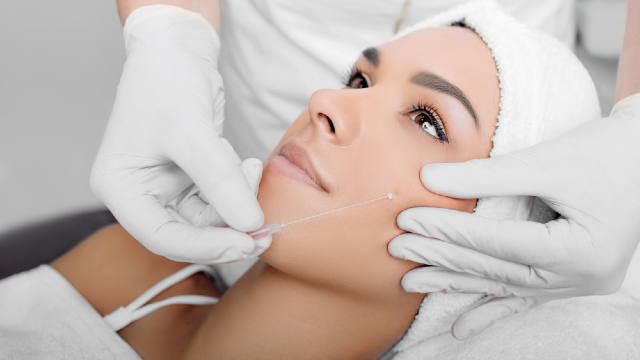
Medically reviewed by Dr. SuHyun Kim, Medical Director, Aube Clinic
Thread lifting is one of the most searched non-surgical options for people who want a firmer, more defined look without surgery, and it is offered in both Korea and the United States. If you are deciding where to have it done, you have probably seen a lot of confident claims about which country is "better." This article deliberately avoids that framing. There is no single right answer, and no honest way to say one country is uniformly superior, cheaper, or safer than another. What there is, instead, is a set of factors you can weigh for your own situation.
This guide walks through those factors evenhandedly — technology and product availability, provider experience, and the practicalities of travel and follow-up care — and stays grounded in one clinical reality that applies everywhere: a thread lift is not a facelift. It produces a subtle, temporary repositioning of soft tissue and a gradual collagen response, not the deeper structural change surgery creates. Results vary between individuals, and no thread system guarantees a specific outcome.
The Bottom Line
- Neither country is universally "better." Korea and the US each have skilled providers and established thread techniques. The right choice depends on your goals, your access to follow-up care, and how you weigh travel against convenience — not on a blanket claim of superiority.
- Product and regulatory availability differ by market. Some thread products cleared by the US FDA (for soft-tissue approximation) are marketed in the United States; other systems are marketed primarily in Korea and are not US FDA-cleared. "Available in Korea" and "cleared by the US FDA" are separate statements worth clarifying.
- Provider experience matters more than geography. Technique, candidate selection, and honest expectation-setting drive results and safety. Evaluate the individual clinician and clinic, wherever they are, rather than assuming a country guarantees a standard.
- Follow-up and travel are real considerations. Thread lifts have an early healing window when issues are easiest to address. Treatment far from home means planning for how aftercare and any complications will be handled.
- A thread lift is not a facelift, anywhere. Results are gradual, subtle, temporary, and individual. This article does not discuss prices; confirm any costs, scheduling, and entry requirements directly with the clinic and the relevant authorities.
What a Thread Lift Is (and Is Not)
A thread lift uses fine, absorbable sutures placed into the deeper layers of the skin. The threads catch lax tissue on their cogs, barbs, or cones and gently reposition it, producing an immediate mechanical lift. Over the following weeks and months, as the body absorbs the thread material, it stimulates a controlled healing response and new collagen forms along the thread's path. The American Society of Plastic Surgeons describes thread lifting as a minimally invasive procedure that both mechanically lifts tissue and stimulates collagen, offering a more gradual and subtle change than surgery.
Because the mechanical component eases as tissue settles and the biological component depends on your own collagen response, the effect is real but temporary. It is also a medical procedure with real, if usually minor and temporary, risks — swelling, bruising, dimpling, thread palpability or extrusion, asymmetry, and infection are among the complications documented in the literature, and published safety reviews stress that technique and candidate selection strongly influence outcomes. None of this changes between countries. What can change is the specific product used, who performs the procedure, and how aftercare is arranged — which is exactly what this comparison is about.
Factor 1: Technology and Product Availability
The single most concrete difference between markets is which thread products are cleared or registered, and that is governed by each country's regulator rather than by prestige.
In the United States, certain thread products carry an FDA clearance. For example, the MINT PDO thread family holds an FDA 510(k) clearance for soft-tissue approximation where a barbed absorbable suture is appropriate, and the PLLA/PLGA cone thread marketed as Silhouette InstaLift holds a 510(k) clearance for mid-face soft-tissue repositioning. It is important to read these clearances precisely: a 510(k) clearance means a device was found substantially equivalent to an existing legally marketed device for a specific indication. "Soft-tissue approximation" is a suture indication — it is not the same as clearance as a facelift, and it does not promise a surgical result.
In Korea, a wider range of thread systems is marketed for aesthetic use, and some of them are not registered or cleared with the US FDA. That is not, by itself, a mark for or against them — many reasonable devices are marketed in one country and not registered in another. But it does mean that "this thread is used widely in Korea" is a different statement from "this thread is cleared by the US FDA," and if regulatory status matters to you, it is worth asking a provider in either country exactly which product they use and what it is cleared or approved for. The practical takeaway is symmetrical: availability differs, precision matters, and neither market's list is automatically superior.
Factor 2: Provider Experience and Technique
Because a thread lift's result depends heavily on planning and placement, the individual provider often matters more than the country. Skilled, experienced clinicians practice in both Korea and the United States, and so do less experienced ones. Rather than reasoning from geography, it is more useful to evaluate the specific clinician and clinic on verifiable grounds: how thorough the consultation is, who actually performs the procedure, how candidly they discuss risks and limits, how they handle candidacy screening, and what aftercare they provide.
Be cautious with credential language in any market. Marketing terms — "expert," "master," manufacturer training designations, or society roles — are not the same as regulatory approvals or medical board certifications, and their meaning varies. A useful habit is to ask what a given title actually certifies and who issued it, rather than taking a superlative at face value. The relevant question is not "which country is better?" but "is this particular provider a good match for my anatomy and goals, and can they show me why?" That question travels well and applies equally on either side of the Pacific.
Factor 3: Travel, Timing, and Follow-Up Care
Thread lifts have an early healing window — the first days to weeks — when swelling, bruising, and settling occur and when any issue such as asymmetry or a palpable thread is easiest to assess and address. Where you have the procedure shapes how that window is managed.
Having a thread lift close to home makes follow-up simple: you can return to the same clinician if something needs attention. Traveling abroad for treatment adds convenience trade-offs that deserve planning. The US Centers for Disease Control and Prevention, which addresses medical tourism from a neutral, safety-focused standpoint, advises travelers to consider continuity of care and to plan for how follow-up and any complications will be handled after returning home, since standards, records, and communication can vary between countries. That guidance is not a warning against traveling; it is a prompt to plan. Practical questions to settle in advance include how many days to stay after the procedure, what aftercare is provided before departure, how the clinic can be reached from your home country, and what the plan is if a concern arises once you are back.
If you are considering travel to Korea specifically, factor in entry requirements as well, and confirm the current rules directly with official sources before booking, because they change. As of this writing, eligible nationals are under a temporary K-ETA exemption through December 31, 2026, during which a K-ETA is not required for short visits; a digital e-Arrival Card is generally expected from travelers who are not using a K-ETA. The K-ETA requirement is scheduled to return on January 1, 2027, and longer or treatment-specific stays may involve a dedicated medical visa such as the C-3-3 category. These are entry logistics, not medical advice, and the authoritative source is the relevant Korean government and consular guidance at the time you travel — confirm current rules before you rely on any of this.
Putting the Factors Together
Weighing these factors is personal arithmetic, not a scoreboard. Someone who values same-clinician follow-up and minimal travel may reasonably prefer treatment close to home. Someone who wants access to a particular technique or clinic, and who can plan realistically for aftercare and the return trip, may reasonably choose to travel. Neither choice is inherently better; they simply optimize for different priorities.
Two boundaries hold in every case. First, whatever the market, the individual provider and the quality of the consultation matter more than the flag on the door — evaluate the clinician, not the country. Second, a thread lift remains a non-surgical, temporary treatment with variable results; if your laxity is advanced, an honest assessment anywhere may point you toward other options rather than promising a surgical-level change. This article intentionally does not compare prices or make cost claims, because a responsible decision about a medical procedure should start with candidacy, safety, and continuity of care rather than a headline number.
How Aube Clinic Approaches This Conversation
Aube Clinic is a non-surgical aesthetic clinic in Seoul focused on facial lifting with threads, injectables, and energy-based devices. For patients weighing where to have treatment, the clinic's approach is to be transparent about what a thread lift can and cannot do, to assess candidacy individually, and to talk through follow-up and travel logistics rather than to make blanket claims about one country being superior. Treatment planning is handled in a one-on-one consultation with Dr. SuHyun Kim, the clinic's Medical Director, who sets realistic, temporary-result expectations rather than promising a fixed outcome. You can learn more about the single-doctor, one-patient-per-visit model on the about us page, and you can ask questions about planning, timing, and aftercare through the contact us page before you travel or book.
Because candidacy, product suitability, and expectations are so individual, the most reliable next step is a personalized assessment rather than choosing a destination from an article.
Frequently Asked Questions
Is it better to get a thread lift in Korea or the United States?
Neither is universally better. Both countries have skilled providers and established techniques, and the right choice depends on your goals, your access to follow-up care, and how you weigh travel against convenience. It is more useful to evaluate the specific clinician and clinic than to reason from the country alone.
Are thread lift products the same in Korea and the US?
Not entirely. Some thread products cleared by the US FDA for soft-tissue approximation are marketed in the United States, while other systems are marketed primarily in Korea and are not US FDA-cleared. If regulatory status matters to you, ask a provider in either market exactly which product they use and what it is cleared or approved for.
Is it safe to get a thread lift abroad?
A thread lift is a medical procedure with real risks in any country, and safety depends heavily on the individual provider, candidate selection, and aftercare. The CDC advises travelers seeking care abroad to plan for continuity of care and to consider how follow-up and any complications will be handled after returning home. Planning for the early healing window is an essential part of doing this responsibly.
How does follow-up care work if I travel for a thread lift?
Follow-up is simplest when you can return to the same clinician, so treatment far from home requires planning. Sensible questions to settle in advance include how long to stay after the procedure, what aftercare is provided before departure, how to reach the clinic from your home country, and what happens if a concern arises once you are back. Arrange this before booking, not after.
Do I need a visa to travel to Korea for a thread lift?
Entry requirements change, so confirm the current rules with official Korean government and consular sources before booking. As of this writing, eligible nationals are under a temporary K-ETA exemption through December 31, 2026, with a digital e-Arrival Card generally expected; the K-ETA requirement is scheduled to return on January 1, 2027, and longer or treatment-specific stays may involve a dedicated medical visa such as the C-3-3 category.
Is a thread lift the same as a facelift?
No. A thread lift is a minimally invasive, non-surgical procedure that provides a lesser, temporary lift, while a surgical facelift physically repositions tissue and is a different category of procedure. This is true in both Korea and the United States. Threads are best suited to mild-to-moderate laxity and cannot replicate a surgical result.
Disclaimer
This article is for general educational purposes about non-surgical aesthetic medicine and is not medical advice, a diagnosis, or a treatment recommendation. It is not a self-diagnosis tool. Thread lifting carries risks, and its results are gradual, variable, and temporary rather than guaranteed. A thread lift is not a facelift. This article does not provide prices or compare costs, and entry and visa requirements change — confirm current rules with official sources. Individual candidacy and outcomes differ, so please consult a qualified physician in person before making treatment decisions.
Clinical Safety Notice & Personalized 1:1 Consultation
All aesthetic and regenerative procedures at Aube Clinic (Hoban Summit Edition 2F, 66 Hangang-daero, Yongsan-gu, Seoul) are planned and performed 1:1 by Representative Director Dr. Suhyun Kim after direct facial anatomy and skin evaluation. Treatment outcomes and recovery timelines vary by individual tissue condition, and temporary swelling, bruising, redness, tenderness, or asymmetry may occur.
1:1 Consultation