
1:1 Consultation
LinearZ Focused Ultrasound Lifting at Aube Clinic, Seoul
How LinearZ focused ultrasound heats the deep dermis and SMAS to stimulate collagen, the facial areas it treats, and what gradual results you can expect.
Aube Clinic · Dr. Suhyun Kim, M.D. · Yongsan-gu, Seoul
1:1 Consultation →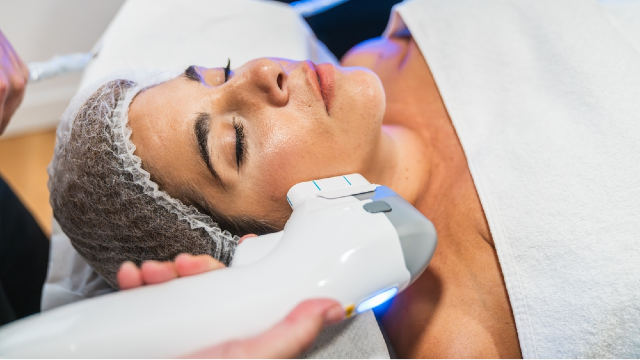
Medically reviewed by Dr. SuHyun Kim, Medical Director, Aube Clinic
Energy-based lifting has become one of the most common ways people look for facial firming without incisions, and focused ultrasound is a central part of that category. At Aube Clinic in Seoul, LinearZ is one of the focused-ultrasound devices used for non-surgical lifting and skin tightening. This guide explains, at a general level, how focused ultrasound works, which facial areas it is typically used to treat, what a realistic results timeline looks like, and where its limits are. It is written to help you ask better questions during a consultation, not to promise a particular outcome.
Two points are worth stating clearly at the start. First, focused-ultrasound lifting is not a facelift and should not be described as an equivalent to surgery; it is a non-surgical treatment that works gradually. Second, LinearZ is a device marketed within the Korean market, and this article does not claim that it is cleared or approved by the U.S. Food and Drug Administration (FDA). Where regulatory status matters to you, it is a reasonable and important question to raise directly with the clinic and to research through official regulators.
What LinearZ Is, in Plain Terms
LinearZ is a focused-ultrasound platform used for aesthetic skin tightening. Rather than describing the marketing name alone, it is more useful to understand the underlying modality: focused (or micro-focused) ultrasound. This is a family of technologies that deliver sound-wave energy to precise, controlled depths beneath the surface of the skin.
Focused ultrasound differs from the diagnostic ultrasound used in, for example, pregnancy imaging. In an aesthetic setting, the energy is concentrated so that it produces a very small, defined zone of heating at a chosen depth while the surface layers are relatively spared. The goal is to create controlled thermal points that prompt the skin's natural repair-and-remodeling process over the following weeks and months.
Because devices in this category vary by manufacturer and by country, the honest framing is a modality-level one: LinearZ delivers focused ultrasound energy for collagen stimulation and tissue tightening. It is used at Aube Clinic as one option within a broader, individually planned approach, and Dr. Kim assesses whether it is an appropriate choice for a given person and concern.
How Focused Ultrasound Stimulates Collagen
The mechanism behind focused-ultrasound lifting is thermal, not mechanical pulling. Published research on micro-focused ultrasound describes how the energy creates small thermal coagulation points at defined depths within the deep dermis and the superficial musculoaponeurotic system (SMAS), the connective-tissue layer that sits beneath the skin and above the facial muscles. At these focal points, tissue temperatures rise into a range that denatures existing collagen and triggers neocollagenesis — the body's formation of new collagen — along with elastin remodeling.
This is why results are gradual rather than immediate. The visible change does not come from the treatment physically lifting tissue on the day; it comes from the wound-healing and collagen-rebuilding response that unfolds over the weeks after treatment. Reviews of micro-focused ultrasound report that this remodeling process can continue for a period of months following a session.
It is also why individual results vary so much. How much new collagen a person produces depends on age, skin thickness, baseline tissue quality, sun-damage history, and general health. A treatment that produces a noticeable improvement for one person may produce a subtler change for another with the same settings. No focused-ultrasound treatment can guarantee a specific degree of tightening.
Delivery modes and precision
Focused-ultrasound systems typically allow the practitioner to select the depth of energy delivery, so that different tissue layers can be targeted for different concerns. Some platforms, including LinearZ, offer more than one delivery pattern — for example, a linear delivery mode for broader coverage and a point or dot-style delivery for more focused areas. The intent of these modes is to let the treating physician match the energy pattern and depth to the region being treated and to the person's tissue, rather than applying a single fixed protocol to everyone.
At Aube Clinic, treatment planning is handled by Dr. Kim during a one-on-one consultation, and the depth, mode, and coverage are selected based on the individual assessment rather than a one-size approach.
Treatment Areas Commonly Addressed
Focused-ultrasound lifting is most often discussed in relation to the lower face and areas where mild-to-moderate skin laxity tends to show. Commonly considered areas include:
- Jawline and lower face — where softening of the jaw contour and early jowling appear.
- Submental area (under the chin) and upper neck — a frequent focus for people concerned about looseness beneath the jaw.
- Cheeks and mid-face — to address mild sagging and a loss of firmness.
- Brow area — a modest brow-lifting effect is one of the outcomes studied for micro-focused ultrasound.
Whether any of these areas is appropriate for you specifically depends on an in-person evaluation. Skin over different regions varies in thickness and in the depth of the underlying structures, which is one reason the treating physician's assessment matters more than a generic area list. During a consultation at Aube Clinic, Dr. Kim evaluates skin thickness, the degree and pattern of laxity, and your goals before recommending whether focused ultrasound, another modality, or a combination is a reasonable fit. You can read more about the clinic's single-physician model on the Aube Clinic about-us page.
What Results and Recovery Typically Look Like
Because the effect depends on collagen remodeling, most people should expect a gradual timeline. Any immediate change after a session is usually minimal, and the more meaningful improvement — where it occurs — tends to develop over roughly two to three months, sometimes continuing for up to about six months as new collagen matures. Some people choose maintenance sessions over time, since the treatment does not stop the natural aging process.
Downtime for focused-ultrasound skin tightening is generally limited. Reported side effects in the literature are usually mild and temporary, such as redness, mild swelling, tenderness, or a sensation of soreness in the treated area, and these typically settle within hours to a few days. Sensation during treatment varies from person to person; some feel brief warmth or a deep prickling at the moments of energy delivery. Your clinician should explain comfort measures and what to expect for your specific plan.
Realistic expectations are essential. Focused-ultrasound lifting is best suited to people with mild to moderate laxity who want a subtle, natural firming and are comfortable with a gradual, non-guaranteed result. It is not a substitute for surgery in people with significant skin excess or advanced sagging, and — to repeat the central point — it is not a facelift. If your goals are more dramatic than energy-based tightening can realistically deliver, an honest consultation should tell you so.
LinearZ, HIFU, and RF: How They Relate
People researching this treatment often encounter the term HIFU (high-intensity focused ultrasound) and ask how LinearZ relates to it. Both fall under the broad umbrella of focused-ultrasound energy used to heat tissue at depth and stimulate collagen. Marketing names differ across devices and regions, but the shared principle is the delivery of concentrated ultrasound energy to targeted layers.
A related but distinct category is radiofrequency (RF) skin tightening, which uses electrical energy rather than sound waves to heat the dermis. RF and focused ultrasound reach tissue in different ways and are sometimes suited to different skin types, depths, or concerns. Neither is universally "better"; the appropriate choice depends on the individual. At Aube Clinic, the decision between an ultrasound-based approach like LinearZ and an RF-based approach is made case by case, based on factors such as skin thickness and the pattern of laxity, rather than defaulting to one device for everyone.
Who Should Be Cautious
General guidance for energy-based aesthetic treatments is that they are not appropriate for everyone. People who are pregnant or breastfeeding, who have active infection or inflammation in the treatment area, who have certain implanted electronic devices, or who have specific skin conditions may be advised to postpone or avoid treatment. Anyone taking medications that affect healing or bleeding should disclose them. These are general considerations, not a complete list — your suitability can only be determined by a qualified clinician who reviews your medical history in person. If you are unsure whether focused-ultrasound lifting is right for you, the safest step is a personalized consultation. You can reach the clinic through the Aube Clinic contact-us page.
The Bottom Line
- LinearZ is a focused-ultrasound device used at Aube Clinic for non-surgical skin tightening; the underlying modality delivers concentrated ultrasound energy to heat the deep dermis and SMAS layer and stimulate new collagen.
- Results are gradual and vary between individuals, typically developing over roughly two to three months and sometimes continuing for up to about six months, rather than appearing immediately.
- Focused-ultrasound lifting is not a facelift and is not a substitute for surgery; it is best suited to mild-to-moderate laxity and offers no guaranteed degree of tightening.
- This article does not claim LinearZ is U.S. FDA-cleared or approved; it is a device used within the Korean market, and regulatory questions should be raised directly with the clinic and official regulators.
- Suitability, treatment areas, depth, and delivery mode are decided during an individual consultation with Dr. Kim, not from a generic protocol.
Frequently Asked Questions
Is LinearZ the same as a facelift?
No. A facelift is a surgical procedure that repositions and removes tissue, whereas LinearZ is a non-surgical focused-ultrasound treatment that heats deeper skin layers to stimulate collagen over time. The two are not equivalent, and focused-ultrasound lifting cannot reproduce surgical results. It is generally more suited to mild-to-moderate laxity.
How does focused ultrasound tighten skin?
Focused ultrasound delivers concentrated sound-wave energy to precise depths, creating small thermal points in the deep dermis and SMAS layer. This controlled heating prompts the body to form new collagen and remodel elastin during the weeks that follow. The tightening effect, where it occurs, comes from this gradual healing response rather than immediate mechanical lifting.
When will I see results, and how long do they last?
Most of the visible change develops gradually, often over about two to three months, and can continue maturing for up to roughly six months. Longevity varies with age, skin quality, and lifestyle, and the treatment does not stop natural aging. Some people choose periodic maintenance sessions, but no specific duration can be guaranteed.
Is LinearZ approved by the U.S. FDA?
This article does not claim that LinearZ is cleared or approved by the U.S. FDA; it is a device used within the Korean market. In the United States, focused-ultrasound stimulator systems for aesthetic use are regulated by the FDA as a device category, but that does not mean any particular branded device carries U.S. clearance. If regulatory status is important to you, ask the clinic directly and consult official regulators.
Does focused-ultrasound lifting hurt, and is there downtime?
Sensation varies; some people feel brief warmth or a deep prickling during energy delivery, and comfort measures can be discussed beforehand. Downtime is generally limited, with any redness, mild swelling, or tenderness usually settling within hours to a few days. Your clinician should explain what to expect for your specific plan.
How is LinearZ different from RF skin tightening?
LinearZ uses focused ultrasound (sound-wave energy), while radiofrequency devices use electrical energy to heat the dermis. They reach tissue differently and may suit different skin types or concerns, and neither is universally superior. At Aube Clinic, the choice between an ultrasound-based and an RF-based approach is made individually based on factors such as skin thickness and laxity.
Who is not a good candidate for this treatment?
Focused-ultrasound lifting may not be appropriate during pregnancy or breastfeeding, with active infection or inflammation in the area, with certain implanted electronic devices, or with some skin conditions. It is also not a replacement for surgery in people with significant skin excess. Only an in-person medical assessment can confirm whether it is suitable for you.
Disclaimer
This article is for general educational purposes about non-surgical aesthetic-medicine treatments and does not constitute medical advice, diagnosis, or a treatment recommendation. Focused-ultrasound lifting is a non-surgical procedure; it is not a facelift, individual candidacy must be assessed by a qualified clinician, and results vary and cannot be guaranteed. This content is not a self-diagnosis tool. Always consult a qualified healthcare professional about your specific situation before making treatment decisions.
Clinical Safety Notice & Personalized 1:1 Consultation
All aesthetic and regenerative procedures at Aube Clinic (Hoban Summit Edition 2F, 66 Hangang-daero, Yongsan-gu, Seoul) are planned and performed 1:1 by Representative Director Dr. Suhyun Kim after direct facial anatomy and skin evaluation. Treatment outcomes and recovery timelines vary by individual tissue condition, and temporary swelling, bruising, redness, tenderness, or asymmetry may occur.
1:1 Consultation