
1:1 Consultation
Jamber Thread Lift: A Guide to This Korean Lifting Technique
Jamber thread lift is a Korean non-surgical technique with absorbable threads. See how it works, who it suits, and what to expect at Aube Clinic in Seoul.
Aube Clinic · Dr. Suhyun Kim, M.D. · Yongsan-gu, Seoul
1:1 Consultation →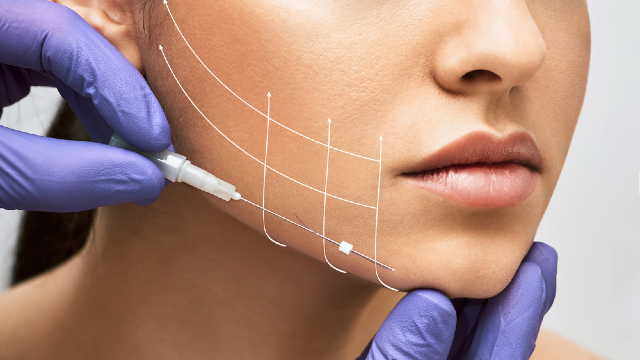
Medically reviewed by Dr. SuHyun Kim, Medical Director, Aube Clinic
If you have been researching non-surgical facial lifting in Seoul, you may have come across the name Jamber. It is one of several absorbable thread systems used in Korea to reposition sagging soft tissue and encourage the skin's own collagen response, without incisions or a surgical recovery. Because Jamber is a Korea-market device rather than a globally distributed product, reliable English-language information about it can be hard to find. This guide explains what the technique involves, how the threads are thought to work, who might be a reasonable candidate, and — importantly — what it can and cannot realistically achieve.
At Aube Clinic in Seoul, thread lifting is not treated as a single fixed procedure. It is one tool within a broader, individualized lifting plan designed around each person's facial structure. Understanding the fundamentals of the Jamber technique before you travel can help you ask better questions during a consultation and set expectations that match what non-surgical treatment can deliver.
The Bottom Line
- Jamber is an absorbable thread system used in a non-surgical lifting technique that both repositions soft tissue mechanically and prompts a collagen-building response in the skin.
- A thread lift is not a facelift. It addresses mild to moderate laxity, and its effects are temporary; results vary from person to person.
- Jamber is a Korea-market device and is not cleared by the US Food and Drug Administration (FDA) for use in the United States. This guide describes the technique at a general level rather than making US regulatory claims.
- Good candidacy depends on your degree of sagging, tissue quality, and goals — factors best evaluated in a one-on-one consultation, not self-assessed online.
- Common temporary effects include swelling, bruising, and tenderness; more significant complications are less frequent when treatment is appropriately planned and performed.
What Is the Jamber Thread Lift?
Thread lifting is a minimally invasive category of treatment in which fine, absorbable sutures are placed beneath the skin to gently lift and support tissue that has begun to descend with age. Jamber refers to a specific brand of thread used within this category. Like most modern lifting threads, Jamber threads are made from an absorbable polymer that the body gradually breaks down over a period of months.
Threads used for facial lifting are commonly grouped by material — polydioxanone (PDO), poly-L-lactic acid (PLLA), and polycaprolactone (PCL) are the most familiar — and by shape, such as smooth monofilament threads, twisted threads, and barbed or cog threads that grip tissue more firmly. The Jamber system is used within this broader family. Because independent, peer-reviewed data specific to the Jamber brand is limited, the most responsible way to understand it is through the well-documented principles that apply to absorbable thread lifting as a whole, rather than through manufacturer marketing.
At Aube Clinic, Dr. SuHyun Kim is documented as a manufacturer-designated "Jamber & Cavern Lifting Key Doctor." It is worth being precise about what that means: a "Key Doctor" designation is a manufacturer or brand designation reflecting product familiarity and training, not a medical board certification or a specialty qualification. It is one data point among many, and it should be weighed alongside a clinic's overall approach to planning, safety, and follow-up care.
How Jamber Threads Work: Mechanical Lift Plus Collagen Response
Absorbable lifting threads are generally understood to work through two complementary mechanisms.
The first is a mechanical effect. When threads are placed along carefully chosen vectors beneath the skin, they can physically reposition and support soft tissue, producing a subtle lift where the threads anchor. Barbed or textured threads are designed to catch tissue and hold it in a slightly elevated position. This mechanical component is what can create a modest, visible change relatively soon after treatment.
The second is a biostimulatory effect. As the thread material sits in the tissue and slowly dissolves through hydrolysis over roughly four to six months, it creates a controlled, low-grade inflammatory response. That response triggers the body's natural wound-healing cascade, which recruits fibroblasts and stimulates the production of new collagen and elastin around the thread pathway. Collagen and elastin are the structural proteins that give skin its firmness and elasticity, so this gradual remodeling is thought to contribute to skin quality even after the thread itself has been absorbed.
Because these two mechanisms operate on different timelines — one relatively immediate, one gradual — the appearance of a thread-lift result can evolve over the weeks following treatment. It is also why results are not permanent: as newly stimulated collagen naturally turns over and tissue continues to age, the effect diminishes and maintenance treatment may eventually be considered.
Jamber Is Not a Surgical Facelift
This distinction matters, and it is one Aube Clinic emphasizes with every patient. A surgical facelift (rhytidectomy) removes and repositions skin and deeper tissue through incisions and can address advanced, significant sagging with long-lasting results. A thread lift does neither. It does not remove skin, and it cannot reproduce the degree or durability of a surgical outcome.
The value of a thread lift lies elsewhere: it is a lower-downtime option for people with mild to moderate laxity who want a subtle refresh rather than a dramatic structural change. Framing it as a "non-surgical facelift" in your own mind can set you up for disappointment. It is more accurate to think of Jamber and similar threads as a way to soften early jowling, support the mid-face or jawline contour, and encourage collagen — with results that are meaningful but modest and temporary.
Regulatory Status: What US Patients Should Know
For patients traveling from the United States, regulatory status is a common and reasonable question. Here is the honest answer: Jamber is a device marketed within the Korean market, and it has not been cleared by the US FDA for use in the United States. That does not, on its own, indicate a safety problem — many products used routinely and safely in one country are simply not submitted for regulatory review in another. But it does mean you should not expect to find US FDA clearance documentation for the Jamber brand, and any source claiming otherwise should be treated with caution.
By contrast, the category of absorbable thread lifting is well described in medical literature and is offered in many countries. When you evaluate a clinic, the more useful questions are about the physician performing the procedure, how the treatment plan is designed for your anatomy, how complications are handled, and what realistic outcome you are being promised. You can read more about how Aube Clinic approaches its treatments on the About Us page.
Who May Be a Candidate?
Thread lifting tends to suit people who are noticing early signs of facial descent rather than advanced sagging. General characteristics that often align with good candidacy include:
- Mild to moderate laxity in the cheeks, jawline, jowls, or brow area
- Reasonably good overall skin quality and elasticity
- A desire for a subtle, natural-looking improvement rather than a dramatic change
- Realistic expectations about the temporary nature of results
- General good health, with no active infection at the treatment site
Thread lifting is generally not the right choice for very heavy or advanced sagging, where a surgical approach may be more appropriate, nor for anyone with certain medical conditions or during pregnancy. Some medications and health factors can also affect suitability and healing. This is precisely why candidacy cannot be determined from an article — it requires an in-person evaluation.
What to Expect: Procedure, Recovery, and Results
A thread-lift session is typically performed under local anesthesia. After the treatment area is cleaned and numbed, threads are introduced through a fine needle or cannula along a planned path, then positioned to create the intended lift. The active treatment portion is usually completed within a single appointment, and no overnight stay is required.
In the days afterward, it is normal to experience some swelling, bruising, tenderness, or a temporary feeling of tightness. Published analyses of absorbable thread lifting consistently report that the most common side effects — such as bruising, swelling, and soreness — are mild and self-limiting, while more significant complications like infection, thread migration, or visible dimpling are comparatively uncommon and are minimized by careful technique and appropriate patient selection. Most people can return to routine activities quickly, though it is sensible to avoid strenuous exercise, facial massage, and extreme facial movements for a short period as advised by your provider.
Results tend to be visible relatively soon after treatment from the mechanical lift, then continue to refine as the collagen response develops over subsequent weeks. How long the effect lasts varies from person to person and depends on the threads used, the area treated, individual tissue characteristics, and lifestyle factors. Because outcomes are temporary, some patients choose to plan for periodic maintenance. No thread lift can guarantee a specific result or duration.
The Role of an Individualized Consultation
At Aube Clinic, thread selection and placement are planned around the individual rather than applied from a fixed template. During a consultation, factors such as the pattern and degree of sagging, skin thickness and elasticity, facial proportions, and personal goals are assessed to determine whether a thread technique is appropriate at all — and if so, which thread type and vector plan make sense. In some cases, a thread approach may be combined with other non-surgical options; in others, it may not be recommended.
This planning step is where much of the real value of an experienced practice lies. If you are considering treatment in Seoul, a thorough consultation with the treating physician should come before any commitment. You can reach the clinic through the Contact Us page to ask about the consultation process and what information to prepare.
Frequently Asked Questions
Is a Jamber thread lift the same as a facelift?
No. A facelift is a surgical procedure that removes and repositions tissue and delivers longer-lasting, more dramatic results. A Jamber thread lift is a non-surgical technique for mild to moderate laxity, and its effects are subtle and temporary. The two are not interchangeable.
How long do Jamber thread lift results last?
Results are temporary and vary from person to person. The mechanical lift is often visible soon after treatment, while the collagen-stimulating effect develops over subsequent weeks. Longevity depends on the threads used, the area treated, and individual factors, so a personalized estimate should come from your consultation rather than a general figure.
Is the Jamber thread system FDA-approved?
Jamber is a Korea-market device and has not been cleared by the US FDA for use in the United States. Absence of US clearance does not by itself indicate a safety concern, but you should not expect US FDA documentation for the brand. Any claim of US FDA approval for Jamber should be treated with skepticism.
Does a Jamber thread lift hurt, and is there downtime?
The procedure is generally performed under local anesthesia, so discomfort during treatment is usually limited. Afterward, temporary swelling, bruising, and tenderness are common for several days. Most people return to normal activities quickly while avoiding strenuous exercise and facial massage for a short period.
How is Jamber different from other thread types like Aptos?
Different thread systems vary in their base material, shape, and design, which can influence how they lift and how the tissue responds. Rather than one thread being universally "better," the appropriate choice depends on your anatomy and goals. A consultation is the proper way to determine which thread type, if any, suits you.
Who should avoid a thread lift?
Thread lifting is generally not suitable for advanced or very heavy sagging, for anyone with an active infection at the treatment site, during pregnancy, or with certain medical conditions that affect healing. Suitability is individual and must be assessed in person by a qualified physician.
Before You Decide
Non-surgical aesthetic treatment is a personal decision that should be made with balanced, accurate information and a professional evaluation. This article is for general education about non-surgical aesthetic medicine; it describes a technique at a general level, individual results vary, and it is not a self-diagnosis tool or a substitute for a consultation with a qualified physician who has examined you.
Clinical Safety Notice & Personalized 1:1 Consultation
All aesthetic and regenerative procedures at Aube Clinic (Hoban Summit Edition 2F, 66 Hangang-daero, Yongsan-gu, Seoul) are planned and performed 1:1 by Representative Director Dr. Suhyun Kim after direct facial anatomy and skin evaluation. Treatment outcomes and recovery timelines vary by individual tissue condition, and temporary swelling, bruising, redness, tenderness, or asymmetry may occur.
1:1 Consultation