
1:1 Consultation
Device-Based Lifting: RF vs Focused Ultrasound Compared
Compare RF and focused ultrasound device lifting: how each energy heats the skin, what gradual results to expect, and how the right modality is selected.
Aube Clinic · Dr. Suhyun Kim, M.D. · Yongsan-gu, Seoul
1:1 Consultation →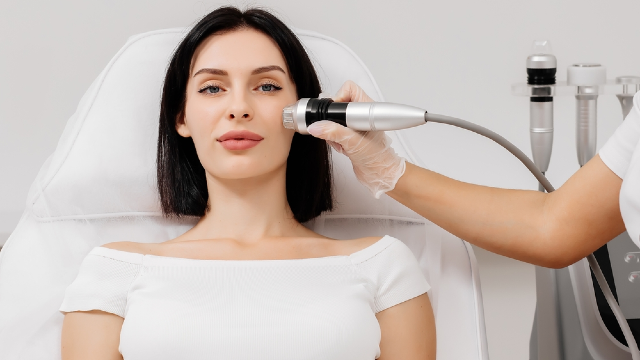
Medically reviewed by Dr. SuHyun Kim, Medical Director, Aube Clinic
If you have researched non-surgical facial tightening, you have almost certainly run into two broad categories of technology: radiofrequency (RF) and focused ultrasound. Both are "energy-based" or "device-based" lifting treatments, both aim to firm and tighten skin without incisions, and both are often marketed with similar language. Yet they work in genuinely different ways, reach different depths, and suit different faces. Understanding that difference is the single most useful thing you can do before deciding which treatment — if either — is right for you.
This guide explains the mechanism behind each modality, what each realistically can and cannot do, and how a clinician thinks through the choice. At Aube Clinic, device-based lifting is offered through two representative systems: Corage, which uses RF energy, and LinearZ, which uses focused ultrasound. We use them as concrete examples throughout, but the principles apply to energy lifting in general.
The Bottom Line
- RF and focused ultrasound both heat the skin to trigger collagen remodeling, but at different depths and in different patterns. RF warms a broad volume of the dermis; focused ultrasound deposits energy at precise points deep in the tissue.
- Neither is a facelift. Energy-based lifting does not cut or reposition tissue surgically. It stimulates a gradual firming response, and results are subtle, build over weeks to months, and vary from person to person.
- The RF technology used in devices such as Corage (marketed as 3DEEP) has a US FDA 510(k) clearance, meaning it was cleared — not "approved" — for marketing in the United States. LinearZ is a Korea-market ultrasound device and carries no US FDA status.
- The "right" modality depends on your skin thickness, the depth of laxity, comfort tolerance, and goals — not on which device is newest or most heavily advertised.
- There are no guarantees. Outcomes depend on individual biology, and some people respond modestly or need maintenance sessions. A qualified in-person assessment is the only way to know if you are a candidate.
What "device-based lifting" actually means
Device-based lifting is a family of non-surgical treatments that use controlled energy to heat targeted layers of the skin and the tissue beneath it. The goal is not to burn or remove tissue but to raise it to a temperature at which existing collagen tightens and the body is prompted to make new collagen over the following weeks and months. This process is called neocollagenesis.
The appeal is straightforward: there are no incisions, usually little to no downtime, and the changes look natural because they emerge gradually. The trade-off is equally important to understand. Because the effect relies on your body's own collagen response, results are inherently gradual and variable, generally more modest than surgery, and typically temporary — collagen turns over, aging continues, and touch-up sessions are often part of the plan.
Within this family, RF and focused ultrasound are the two dominant approaches, and the difference between them comes down to physics.
How radiofrequency (RF) lifting works
Radiofrequency devices pass a high-frequency electrical current through the skin. Because tissue resists that current, it heats up — much the way any conductor warms when electricity flows through it. RF systems are engineered to concentrate this heating in the dermis, the collagen-rich layer beneath the surface, while sparing the outermost epidermis.
When the dermis is warmed into the target range, a portion of the collagen partially denatures. In peer-reviewed reviews of RF for facial rejuvenation, this controlled heating is described as causing immediate collagen contraction followed by a wound-healing cascade that stimulates new collagen and elastin over roughly the next several months. The practical signature of RF is bulk, volumetric dermal heating: energy is spread through a comparatively broad region of tissue rather than concentrated at single points.
This has a few consequences. RF tends to be comfortable and is often described as a warm, sometimes intense sensation rather than sharp pain; many RF treatments require no anesthesia. It is frequently used for overall skin tightening, refinement of texture and tone, and mild-to-moderate laxity. Multi-source, phase-controlled RF designs — the category the 3DEEP technology belongs to — were developed specifically to deliver heat deeper and more evenly while protecting the surface.
Regulatory note: The 3DEEP RF technology, used in devices in the Corage family, has received US FDA 510(k) clearance (for example, an EndyMed 3DEEP RF system cleared under 510(k) number K120513). A 510(k) clearance means the FDA determined the device is substantially equivalent to a legally marketed device; it is correctly described as "cleared," not "approved." Clearance speaks to a marketing pathway, not a promise of results for any individual.
How focused ultrasound lifting works
Focused ultrasound takes a different physical route to a similar biological goal. Instead of an electrical current, it uses sound-wave energy focused to specific depths. At the focal point, mechanical vibration converts to heat rapidly and intensely, briefly raising the temperature high enough to create tiny, discrete zones of controlled thermal injury deep in the tissue.
In the published literature these are called thermal coagulation points. Micro-focused ultrasound can produce coagulation points smaller than a cubic millimeter at set depths, in some systems reaching the mid-to-deep dermis and the tissue plane beneath it, while leaving the layers above the focal point untouched. Each of these points denatures a small amount of collagen and sets off a localized healing and remodeling response, so that new collagen and elastin form around the treated zones over the following weeks.
The signature of focused ultrasound is therefore precise, point-by-point energy delivery at depth, rather than the broad warming of RF. Because it can reach deeper structural planes, it is often discussed in the context of lifting deeper laxity. The sensation during treatment is different too: many people feel brief, sharp or hot pulses at the moment energy is deposited, which some find more intense than RF.
Regulatory note: LinearZ is a focused-ultrasound device marketed in Korea. We describe it at the level of its modality — focused ultrasound — and make no US FDA claim about this specific unit, because it does not carry a US regulatory status. When you read about ultrasound "lifting" more generally, remember that clearances apply to specific named devices, not to a whole category.
RF vs focused ultrasound: the practical differences
Placed side by side, the contrast becomes clear:
- Energy type: RF uses electrical current that heats tissue through resistance; focused ultrasound uses sound waves focused to a point.
- Heating pattern: RF produces broad, volumetric dermal heating; focused ultrasound produces discrete thermal coagulation points.
- Depth: RF is typically tuned to the dermis and can be layered across depths; focused ultrasound is often used to reach deeper planes at precise focal distances.
- Sensation: RF is generally a diffuse warmth; focused ultrasound is often felt as brief, more pointed pulses.
- Best-suited concerns: RF is frequently chosen for overall tightening, texture, and milder laxity; focused ultrasound is often considered for deeper, more structural laxity — though real-world selection depends on the individual.
Neither is universally "better." A clinic that markets a single device as the answer for everyone is oversimplifying. In practice, skin thickness, the depth and pattern of laxity, prior treatments, pain tolerance, and your goals all feed into the decision, and some people are better served by one modality, some by the other, and some by a combination over time.
What device-based lifting is not
It is worth stating plainly: energy-based lifting is not a facelift. A surgical facelift physically repositions and, where appropriate, removes tissue; it is a different category of procedure performed by surgeons, with different risks, recovery, and results. Device-based lifting works by coaxing your own tissue to firm gradually. If your primary concern is significant sagging, no energy device will replicate a surgical result, and honest expectation-setting is part of a responsible consultation.
Two more realities matter. First, results are gradual and variable. Because the effect depends on your body's collagen response, some people see a clear improvement while others notice only a subtle change, and the full effect typically unfolds over weeks to a few months rather than appearing immediately. Second, results are not permanent. Aging continues, collagen remodels, and maintenance sessions are often recommended to sustain the effect.
What a session typically involves
While the exact routine depends on the device and the area treated, most energy-based lifting sessions follow a broadly similar arc. After cleansing, the clinician maps the treatment zones and, for some devices, applies a coupling gel or a numbing preparation depending on the modality and your comfort. The handpiece is then moved across the skin, delivering energy in passes or points. RF treatments are often experienced as a building warmth that the clinician adjusts in real time; focused ultrasound is delivered as discrete pulses at set depths. A typical facial session runs from a few minutes to under an hour, again depending on the device and the areas addressed.
Afterward, one of the practical advantages of device-based lifting is that downtime is usually minimal. Mild redness, temporary warmth, slight swelling, or tenderness can occur and generally settle within hours to a few days, though reactions vary. Because the collagen response unfolds slowly, you should not expect a dramatic change the moment you leave; the point of these treatments is a gradual refinement rather than an instant transformation. Some protocols involve a single session with periodic maintenance, while others are structured as a short series — the plan is individual.
It is also worth being realistic about who benefits most. Energy-based lifting tends to suit people with mild-to-moderate laxity and reasonable skin quality who want subtle firming without surgery and are comfortable with results that build over time. People with more advanced sagging, or those seeking an immediate and pronounced lift, are often better served by a frank conversation about alternatives, including whether a non-surgical option is realistic for their goals at all. A responsible provider will tell you when a device is unlikely to deliver what you are hoping for.
How the right modality is chosen at Aube Clinic
Rather than defaulting to one machine, our approach is to assess the individual first. During an in-person consultation, Dr. SuHyun Kim evaluates factors such as skin thickness and quality, the depth and distribution of laxity, your history of prior treatments, and your goals and comfort preferences. From there, the discussion turns to whether RF (as in Corage), focused ultrasound (as in LinearZ), a staged combination, or a non-device option better fits — or whether device-based lifting is appropriate for you at all.
This individualized selection is the point. The same face can respond differently to broad dermal heating versus focused deep energy, and matching the tool to the tissue is more important than the brand name on the handpiece. You can learn more about our single-doctor, one-patient-per-visit model on our about us page, and you can arrange an assessment through our contact us page.
Frequently Asked Questions
Is RF or focused ultrasound better for lifting?
Neither is universally better; they suit different situations. RF delivers broad dermal heating and is often used for overall tightening and milder laxity, while focused ultrasound concentrates energy at precise deeper points and is often considered for deeper laxity. The right choice depends on your skin and goals, which is why an in-person assessment matters.
Does device-based lifting hurt?
Comfort varies by modality and by person. RF is usually experienced as a spreading warmth and often needs no anesthesia, while focused ultrasound is frequently felt as brief, more pointed pulses that some people find more intense. Your clinician can discuss comfort measures and what to expect for the specific device recommended for you.
Is the 3DEEP RF technology FDA approved?
It is more accurate to say it is FDA "cleared," not "approved." The 3DEEP RF technology used in Corage-family devices has a US FDA 510(k) clearance, which reflects a marketing pathway based on substantial equivalence to existing devices. Clearance is not a guarantee of a particular result for any individual, and it does not extend to every ultrasound or RF device on the market.
Is LinearZ FDA approved in the United States?
LinearZ is a focused-ultrasound device marketed in Korea, and we make no US FDA claim about this specific unit. Regulatory clearances apply to particular named devices, so the fact that some ultrasound systems carry US clearances does not mean every ultrasound device does. Ask any provider to clarify the exact regulatory status of the specific device they use.
How long do results last, and when will I see them?
Results are gradual and vary from person to person. Because the effect depends on your own collagen remodeling, improvement typically builds over several weeks to a few months rather than appearing at once. Results are also temporary; aging continues over time, and maintenance sessions are commonly part of a longer-term plan.
Can I have RF and ultrasound treatments combined?
In some cases a staged combination is considered, because the two modalities heat tissue differently and may address different aspects of laxity and texture. Whether that is appropriate depends entirely on your individual assessment. This is a decision to make with your clinician rather than a default protocol.
Is device-based lifting a replacement for a facelift?
No. Energy-based lifting does not surgically cut or reposition tissue and cannot replicate the results of a surgical facelift. It is a non-surgical option that stimulates a gradual firming response, and it is best suited to milder concerns and to people who prefer to avoid surgery, with realistic expectations.
Disclaimer
This article is for general educational purposes about non-surgical aesthetic medicine and is not medical advice, a diagnosis, or a treatment recommendation. It is not a self-diagnosis tool. Individual candidacy, risks, and outcomes vary, and energy-based lifting produces gradual, variable, and temporary results rather than guaranteed ones. Please consult a qualified physician in person to determine whether any treatment is appropriate for you.
Clinical Safety Notice & Personalized 1:1 Consultation
All aesthetic and regenerative procedures at Aube Clinic (Hoban Summit Edition 2F, 66 Hangang-daero, Yongsan-gu, Seoul) are planned and performed 1:1 by Representative Director Dr. Suhyun Kim after direct facial anatomy and skin evaluation. Treatment outcomes and recovery timelines vary by individual tissue condition, and temporary swelling, bruising, redness, tenderness, or asymmetry may occur.
1:1 Consultation